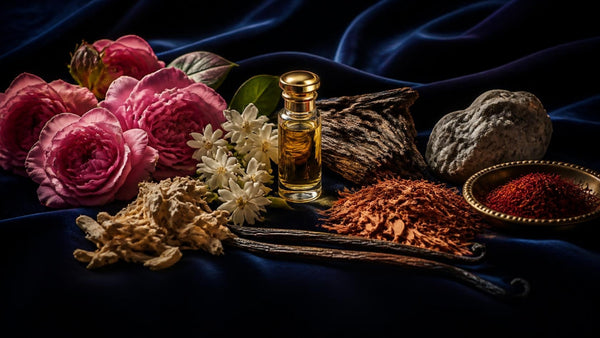
Liquid Gold: The 8 Most Precious Ingredients in Perfumery
Roots that rest for years, a resin born from a wounded tree, a treasure the ocean returns to the shore. The stories behind the rarest materials in fine fragrance, and how to find them in a bottle.
Why can two fragrances that look alike on paper cost and feel so differently? Often the answer is hidden in a handful of extraordinary raw materials. Some take years to prepare, some need millions of flowers picked by hand, and some come from places you would never imagine. Here are eight of the most precious, and what they bring to your skin.
1. Orris: the root that waits for years
Orris comes not from the iris flower but from its root. The rhizomes are harvested, dried and left to rest for around three years or more, slowly developing the molecules that give iris its powdery, velvety, almost cool scent. It takes a huge amount of root to produce a little orris butter, which is why orris is often described as costing more than gold.
On the skin: soft, powdery, elegant, like suede and cool petals.
2. Oud: the treasure of a wounded tree
Oud is formed inside the Aquilaria tree. When the tree is wounded and infected, it defends itself by producing a dark, fragrant resin in its heartwood. Only a small share of wild trees form it naturally, and good oud can take many years to develop. For this region, oud is more than a note: it is heritage, hospitality and identity.
On the skin: deep, woody, smoky and resinous, sometimes animalic, always unforgettable.
3. Ambergris: a gift from the ocean
Natural ambergris forms in the digestive system of the sperm whale. Once expelled, it can float on the sea for years, while sun, salt and water slowly transform it from something unpleasant into a warm, sweet, salty and luminous material. Lucky finds are washed up on beaches. Because it is so rare, and its trade is restricted in some countries, most perfumes today use refined amber molecules such as Ambroxan that recreate its glow.
On the skin: warm, skin-like, mineral, with a glow that makes everything around it last longer.
4. Taif rose: Saudi Arabia's pink gold
In the mountains of Taif, the fragrant Taif rose is harvested by hand each spring, at dawn, when its scent is strongest. Tens of thousands of roses go into a single tola of rose oil, the traditional small measure of precious oils in the region. Taif rose is prized for a scent that is fresh, spicy and honeyed at once, and it has become a source of pride far beyond the Kingdom.
On the skin: radiant, fresh and lightly spicy, a rose with real character.
5. Jasmine: millions of flowers before sunrise
Jasmine is picked by hand at dawn, flower by flower, during a short season. In Grasse, the historic home of French perfumery, around 650 kilograms of flowers are needed for one litre of jasmine absolute. No wonder perfumers call jasmine one of the two queens of the floral world, alongside the rose.
On the skin: rich, sensual, slightly fruity and warm.
6. Sandalwood: patience in wood form
Sandalwood's creamy scent lives in the heartwood of mature trees, which need decades to develop it. Mysore sandalwood from India became so prized that over-harvesting led to strict controls, and today much of the sandalwood in perfumery comes from carefully managed plantations and from modern sandalwood molecules.
On the skin: creamy, milky, soft and woody, the perfect base for oud and rose.
7. Saffron: the red thread
Each saffron flower gives only three red stigmas, picked by hand. It takes well over a hundred thousand flowers to produce a single kilogram. In perfume, saffron adds a leathery, slightly metallic warmth that has become a signature of many modern oriental and niche fragrances.
On the skin: warm, leathery, honeyed and luxurious.
8. Vanilla: the orchid pollinated by hand
Vanilla is the fruit of an orchid. Outside its native Mexico, almost every flower must be pollinated by hand, on the single day it opens. The green pods are then cured for months until they turn dark and fragrant. Much of the world's finest vanilla comes from Madagascar.
On the skin: sweet, creamy, woody and comforting, far deeper than dessert vanilla.
Good to know: "natural" does not automatically mean "better", and modern molecules are not a cheap trick. Great perfumers blend precious naturals with refined synthetics to give a fragrance balance, safety, consistency and longevity. What matters is the quality of the whole composition.
How to find these treasures in a bottle
- Read the notes: look for iris or orris, oud, ambergris or amber, Taif rose, jasmine, sandalwood, saffron and vanilla.
- Look to niche houses: many are known for generous use of rare materials, and their fragrances often show them clearly.
- Give it time: precious materials reveal themselves in the heart and the base, hours after the first spray.
Next time you hold a bottle, think of the roots resting in the dark, the roses picked at dawn in Taif and the oud that took years to form. That is what fine perfume is made of. Follow PFL Scent Club for more stories from the world of fragrance.
Ready to find your scent?
Answer a few simple questions and get matches in 30 seconds.
More from the club
 PFL SCENT CLUB
35
The Best Luxury Vanilla and Amber Perfumes That Last in Saudi Arabia
November 2026
Seven warm, long-lasting vanilla and amber perfumes we love, how vanilla and amber smell in niche and designer fragra...
Read the article
 PFL SCENT CLUB
34
The Best Unisex Perfumes in Saudi Arabia
November 2026
What makes a perfume unisex, eight of our favourite shared scents across citrus, floral, oud, amber and musk, and sim...
Read the article
 PFL SCENT CLUB
33
How Does an Original Perfume Reach You in Saudi Arabia?
November 2026
Follow an original perfume step by step, from the fragrance house to the official agent in the Kingdom, to Perfumes F...
Read the article